Case study 03 · AI & research
Synthetic Research
Stress-testing concepts in minutes instead of weeks — through a persona grounded in our own user evidence.
Challenge
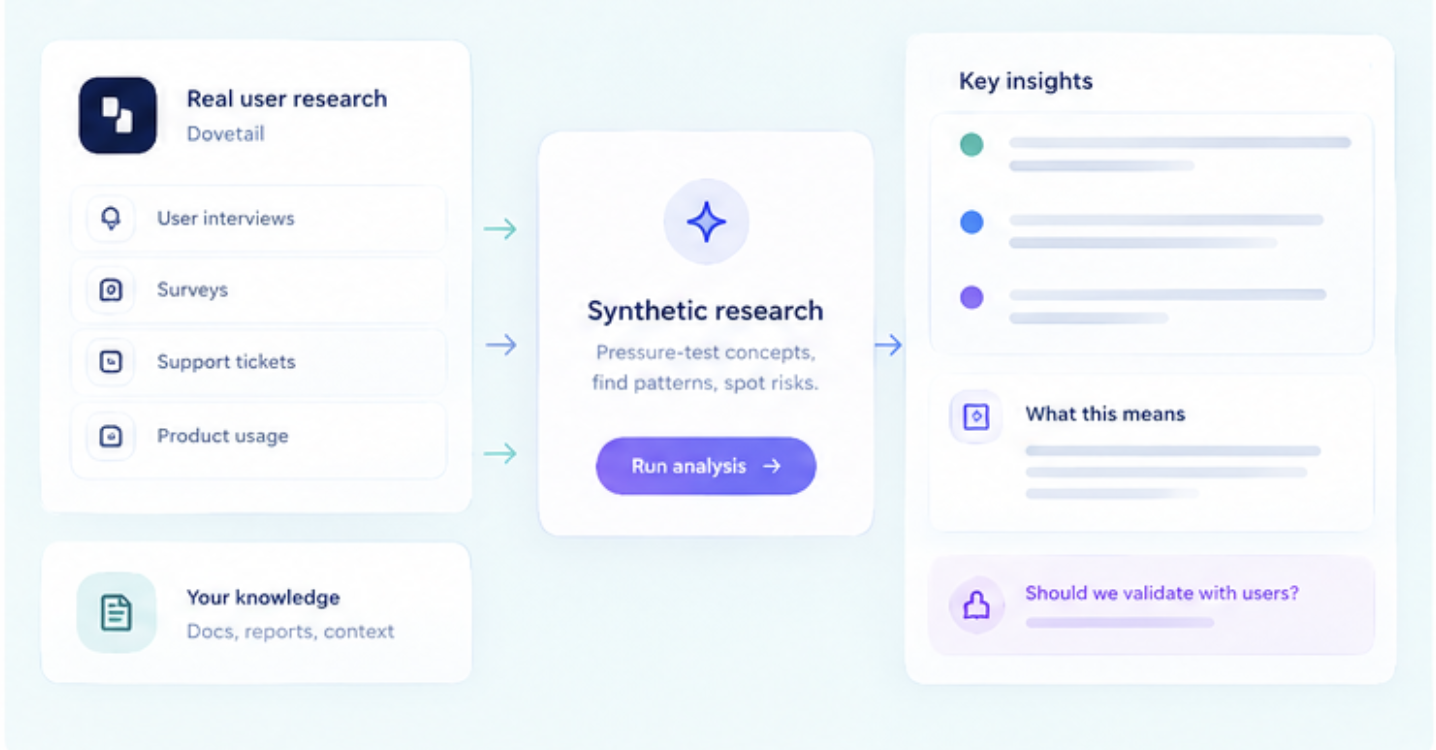
Real-user research remained essential, but its cadence couldn’t always keep pace with product decisions. The challenge was to provide teams with grounded feedback between research cycles — without replacing real-user research.
My role
Defined the strategy, created and piloted the Synthetic Research Skill, and led its adoption across the organization.
The starting point
Research cadence didn’t match product cadence.
Recruiting constraints made it difficult to get user input at the moment a concept needed to be tested.
Heavy approval chain
Recruitment requires multiple stakeholder approvals before we can even reach users.
No-shows & scheduling
Even after approval, calendar constraints and last-minute cancellations can push interviews into the next cycle.
The answer is not to replace user research. It is to extend it.
Recurring user sessions continuously feed the evidence base in Dovetail. Synthetic research uses that accumulated evidence to pressure-test concepts between research cycles — helping the team move faster while keeping real users at the center.
01 · How it works
From inputs to a research report
Time to first user signal
2–4 weeksMinutes
For a first structured critique of a concept.
Five explicit stages turn a concept and a grounded research protocol into a structured critique in minutes.
- 3 inputsWhat goes in• Research protocol & questions • Prototype or concept to review • Target persona
- GroundingEvidence retrievalPulls fresh context for the persona: Dovetail, JTBD, persona docs, Mobbin, web sources.
- Step 1Individual reactions5 lenses react independently; each prompt runs 5–10× to measure variance.
- Step 2Debate on divergenceThe lenses argue the contradictions surfaced in step 1.
- OutputA research reportOpportunities, risks, recommended changes, confidence levels, next research step.
02 · One grounded persona. Five evaluation lenses.
Not five different users — five critical questions the same persona weighs
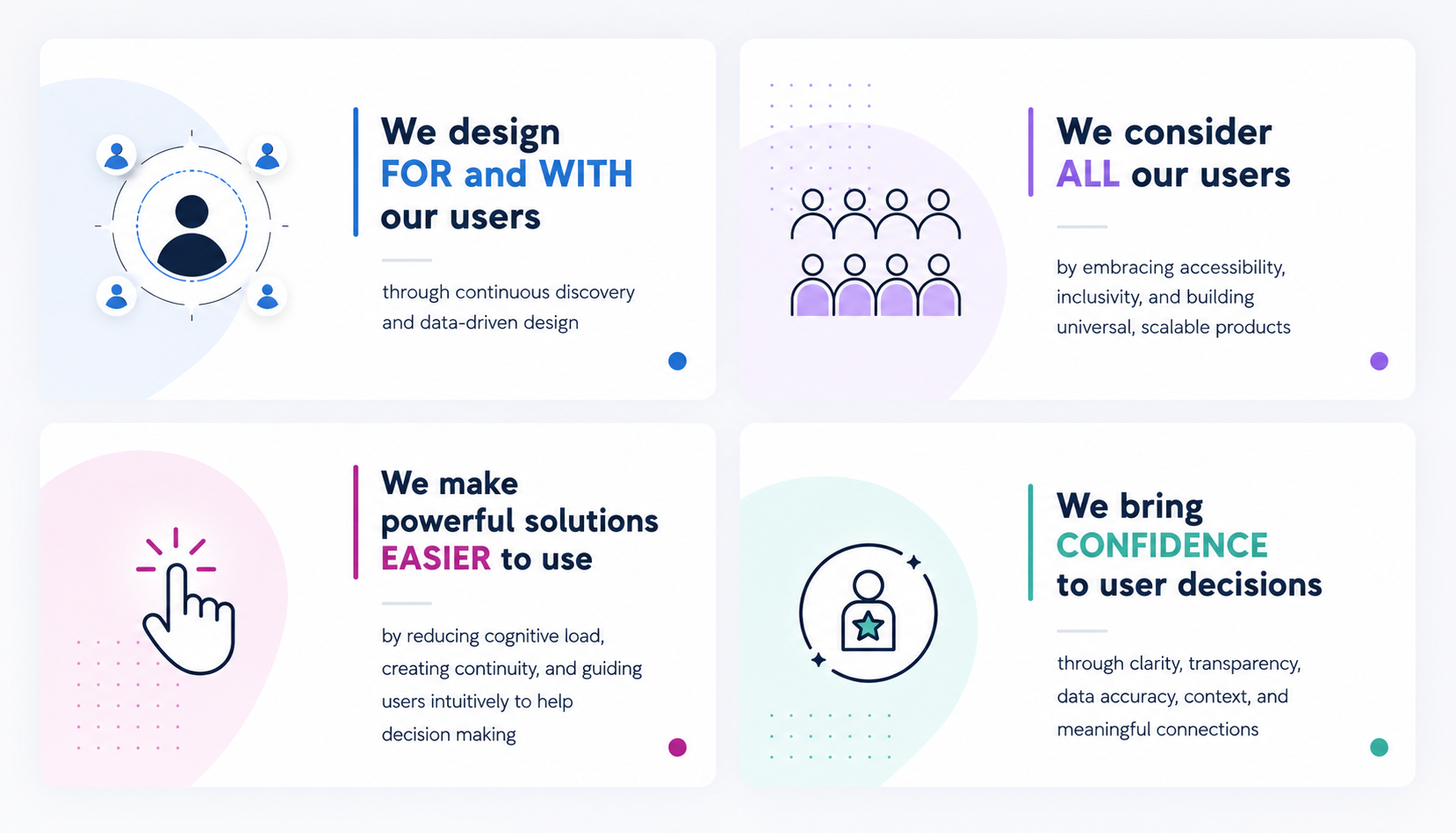
Each lens examines the concept from a different perspective — task efficiency, business outcomes, inclusion, familiar UX patterns and trust — while remaining grounded in the same target persona.
Task-first
"Does this help me do my job faster and better?"
EASIER to use
Business-outcome
"Does this help me make better decisions and drive measurable impact?"
FOR and WITH users
Inclusive
"Can all users understand and use this — any ability, language, device or literacy?"
ALL our users
UX-pattern
"Does it feel familiar and intuitive?"
EASIER to use
Trust
"Can I trust the recommendation or output?"
CONFIDENCE
03 · What makes it credible
The system does not invent a generic user
It draws from a research repository built from 200+ participants across 50+ brands, combining direct user evidence with product context and external standards.
- Dovetail
Real user evidence
Our own users speaking
- Direct quotes
- Insight tags
- Observed behaviors
- Internal docs
Product-specific context
Who they are, what they're trying to do
- JTBD documents
- Persona files
- Our 4 UX principles
- UI libraries + web
External standards
Industry patterns & best practices
- Mobbin (via connector), SaaS UI Design, Aiverse
- Nielsen Norman heuristics
- WCAG accessibility + AI design guidelines
04 · Built as a Claude Skill
A reusable workflow for the whole team
The whole protocol is packaged as a Claude Skill — invoked by name, no prompt engineering required. It is deployed once in our Claude Team workspace and available to every member automatically, and it reviews concepts in the same place we design them, including prototypes generated as Artifacts.
Why it matters
Credible by construction
Responses are grounded in retrieved user evidence rather than relying on model intuition alone.
Reusable by anyone
A named skill gives every designer the same protocol without additional setup.
Lives where we design
It reviews concepts and prototypes in the same workspace they're created in.
05 · A worked example
Using the skill on the survey redesign
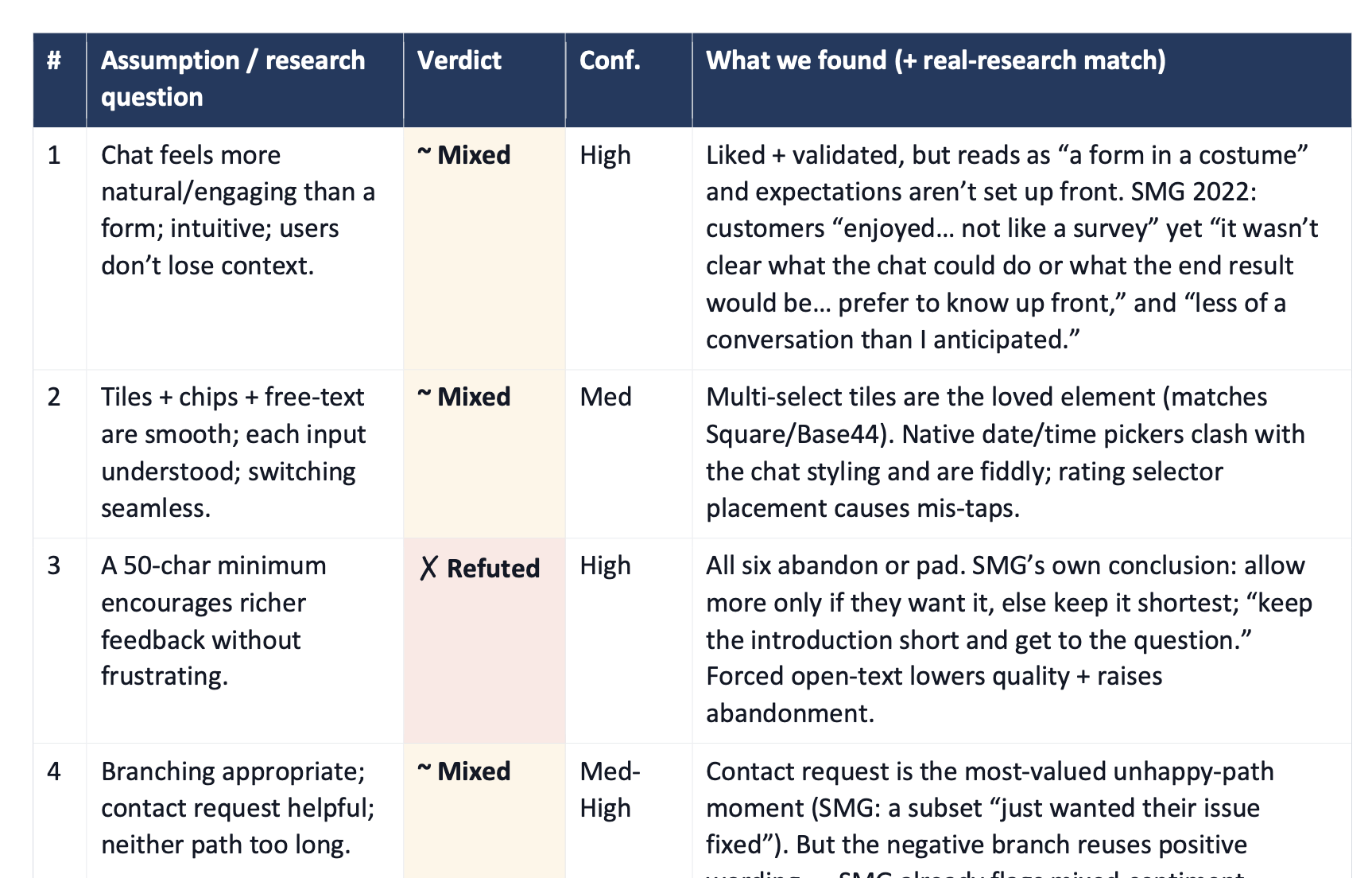
We ran the skill on the Claude Design prototype, using the research questions and target personas as inputs. The output was a report with hypothesis verdicts and confidence levels.
Feedback 1 & 2
Make the experience feel like a conversation
Users liked the conversational direction, but the interaction model felt inconsistent. Standard form controls — especially the date/time picker — pulled the experience back toward a traditional form.
Evidence — Previous SMG study: “Less of a conversation than I anticipated.” Previous research also found ≈4× higher completion for conversational surveys (~85% vs ~22% · SurveySparrow), 2.2× completion (54% chatbot vs 24% form · ACM), and ≈2.5× longer open answers (65% rated top quality vs 13%).
Feedback 3
Make open text optional
The 50-character minimum created friction without necessarily improving the quality of the response. The goal was to collect the shortest useful answer, while giving people the opportunity to say more when they wanted to.
Evidence — Previous SMG study: “If users want to talk more, we should allow that. Otherwise, aim for the shortest collection possible.” Comparable patterns from Base44, Square and Binance also make open text optional rather than enforcing a minimum response length.
The outcome
Faster research, grounded in real users
Synthetic research became a layer between research cycles — allowing teams to pressure-test concepts in minutes against accumulated user evidence, while using the questions and uncertainties it surfaced to inform the next round of real-user research.
Weeks → minutes
research turnaround
100%
feature team adoption
90%+
real-user feedback anticipated
Real user research
Direct conversations and observed behaviour
Dovetail
Research insights & evidence
Synthetic research
Pressure-test concepts + identify risks and questions
Next case study